
Skip to content

Environmental Product Declaration (EPD)

Transparency regarding environmental impacts is a key requirement for making sustainable choices in construction. To calculate the carbon footprint of buildings, Environmental Product Declarations (EPDs) are used for building materials; these documents report on the environmental impacts of the products used. EPDs are based on life cycle assessment (LCA), in which the environmental impacts of a building material are evaluated over the product’s entire life cycle.

To ensure the reliability of EPD data, it is prepared in accordance with the European standard EN 15804 and verified by an independent third party in accordance with ISO 14025:2010. Verification confirms that all information presented in the EPD is accurate and meets the specified requirements. The Environmental Product Declaration of Rakennustieto is a Type III environmental label and indicates that Peltitarvike’s EPDs have been verified by a third party.
Environmental Product Declaration EPD

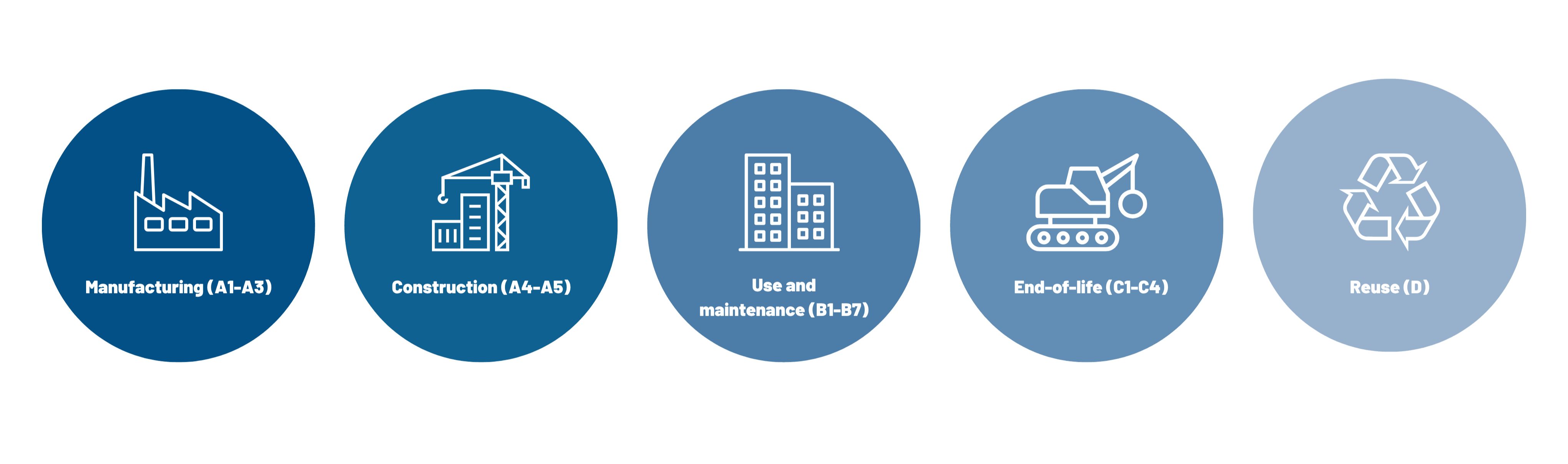
An EPD provides a detailed breakdown of a single product’s environmental impacts throughout its entire life cycle, from raw material sourcing to final disposal. The declaration breaks down the product’s life cycle into stages and lists, among other things, the GWP (Global Warming Potential) values for each stage.

Stages A1–A3 describe a product’s environmental impacts from raw material sourcing to product manufacturing. Stages A1–C4, on the other hand, describe the environmental impacts of a product’s entire life cycle, including the manufacturing process. However, the values for stages A1–A3 play a particularly important role in assessing the actual environmental impacts of products, as they are based on concrete data from the manufacturing process, unlike the values for the final stages (A4–C4), which are based purely on estimates of the products’ future use.

EPD stages

Actions we take to reduce the environmental impacts of our products

  • Steel is one of the most durable materials, so our products perform exceptionally well in their intended use for decades. The long lifespan of our products can also be explained by the fact that steel is one of the few materials that can be recycled repeatedly at the end of a product’s life without loss of quality.

  • Our in-house production allows us to accurately assess the environmental impact of the manufacturing process. Centralizing production under one roof also significantly reduces transportation emissions associated with manufacturing.
  • We have been able to effectively reduce the carbon footprint of our products thanks to our own solar power plant. In the summer, the solar power plant generates all the electricity needed for our production and even more than we need. We sell the excess energy. 

We are constantly improving our operations and seek to further reduce the carbon footprint of our products by optimizing and streamlining our manufacturing processes, for example by minimizing scrap metal.

Tämän voisi ainakin kokonaan jättää pois? Ja tästä alkaisi tarkempi Peltitarvike osio

EPD-selosteessa tuotteen ympäristövaikutuksia on GWP-arvon lisäksi kuvattu useilla erilaisilla indikaattoreilla, joilla arvioidaan muun muassa: TÄMÄ AIHE VÄHÄN KYSYMYSMERKKI?

  • ilmastonmuutoksen vaikutuksia
  • tuhoavia aineita, jotka ohentavat otsonikerrosta
  • maaperää ja vesistöjä happamoittavat päästöjä
  • vesistöjen rehevöitymistä aiheuttavia päästöjä
  • uusiutumattomien energiavarojen ja mineraalivirtojen ehtymistä